Monday, April 21, 2008

For Young Professionals

Some good resources from IDEALIST

Nonprofit Career Resources

The Idealist Guide to Nonprofit Careers

A free, comprehensive online career guide with chapters on assessment, networking, negotiation, and much more! www.idealist.org/careerguide


Self-assessment

The Idealist Guide Self-Assessment section:

Career Tracks and Four Lenses:

Financial Assessment guide:


Networking

Realtime networking events

Idealist Groups:

Green Drinks:

Young Professionals of America (YPOA):

World Affairs Council-Young Professionals Network:

Young Women Social Entrepreneurs (YWSE):

Young Nonprofit Professionals Network (YNPN):


Online networking

These can be great networking tools but only if used responsibly!

LinkedIn:

FaceBook:

MySpace:


Information about the Non profit sector

Idealist.org—Search over 7,000 jobs, 11,500 volunteer opportunities, and 1,500 internships:

Sign up for personalized email alerts:

NYU Wagner School of Public Service professional associations:

Guidestar.org:


Publications to read

Chronicle of Philanthropy:

Stanford Social Innovation Review:

Nonprofit Times Weekly:


Blogs to check (there are plenty of others, but these are a good start)

Idealist blog (on our homepage, left side):

Social ROI:

Mission Based Management:

Nonprofit Blog Exchange:

Have Fun*Do Good:

WorldChanging:


Research to peruse

Ready to Lead: a new survey on next generation nonprofit leaders:

Stepping up or Stepping Out: a YNPN survey on the readiness of next generation nonprofit leaders:


Find jobs, internships, volunteer opportunities

CommonGood Careers:

CraigsList

VolunteerMatch:

LBVision Volunteer Center:

United Way:


For Job Seekers

International Development Job Search Engines

Networking
Connections are extremely important when it comes to finding the job you're looking for. Big cities like Washington, Geneva, New York, Rome, Brussels and other capital of the international development arena are filled with venues for networking. Ranging from parties at bars and restaurants to more formal meetings and workshops, these are good opportunities to meet that person, who knows somebody whose sister is looking for someone like you. Don't believe me? check this out:

Organizations use the following recruitment channels:
  • Word of mouth (99%)
  • Current employee referrals (93%)
  • Local newspapers (80%)
  • Postings on others’ websites (73%)
  • Recruitment from recent interns (67%)
  • Postings on organization’s own website (64%)
(Data from the Johns Hopkins Nonprofit Listening Project [Workforce Recruitment and Retention Soundings, 2007])

So your first step should be to find out what's out there. Join academic and professional associations (see if Society for International Development has a chapter in your city, join AIARD), interest groups (meetup), subscribe to listserv and calendars so you know what's going on in your city. Remember that most organizations are constantly opening their doors to the public with different types of events; fund raising, presentations, open houses, etc. While you start to attend networking events, workshops and other type of presentations, keep these tips in mind:

1) be sincere about your interest.

2) look neat. first impression is very important. Check out this article by the Economist.

3) have business cards, you don't want to be looking for a pen and a piece of paper in the middle of an engaging conversation. vistaprint will send you cards for free, you can choose from their several templates and just pay for shipping (about $7). After two week you'll get a box with 250 cards.

4) do you homework. read not only about the topic to be discussed but also about the speakers.

5) participate. i know public speaking can be a pain, but the Q&A session could be that great opportunity to meet people by putting on the table well-thought questions or comments. Also, seat at front.

6) follow up with emails. If you meet someone that told you about his research on family planning in Mali and you come across an article on the subject, send it to himright away, i'm sure it would be greatly appreciated, even if he already knows about it.

7) organize your contacts and remember how you meet them. For instance, you may write on their business card "World Bank presentation 03/21/07, interested in micro credit in Brazil". Also, file the documents along with your notes in a way that can be easily retrievable.
what else......
ah, for the business card, go to staples and buy a plastic card holder, this is a cheap way to organized your contacts on a binder. Again, keep it organized e.g. school, NGOs, government etc, whatever works for you, keeping in mind that two years for now you may need that contact and you better know where to find him and how you met him/her.

8) Also, take advantage of technology. Use your email account to organize your contacts, create a linkedIn account, use facebook, maybe a friend of you has a good friend at the place where you want to work. Create a blog with my link on it :)


Then What?
So you made a contact at organization you want to work for. You may choose to go the traditional way and apply to that full time position they have listed on their website. You may also consider other ways to get involve with the organization in you quest for getting that full time position you want. A good way to do this is by volunteering, interning, engaging in board service, asking for an informational interview or consulting for them. Consider this:
  • 50% of organizations recruit interns to fill openings
  • 40% of nonprofits use consultants to find candidates to fill positions
  • 33% of organizations recruit volunteers to fill openings
So you met Dr. Patterson at a presentation on rural infrastructure in Bangladesh. You do some small talk, get his card. Then you learn about his work, his papers and more important his current research or projects. After this, you send him an email saying how you found one of his papers very interesting and relevant to the work you're doing. You ask him a couple questions. After that maybe you can ask him for a cup of coffee. (then you propose). Then you may want to express your interest in helping him with whatever he is doing....anyway, you get the picture.

Again, it is very important you are completely sincere about your interest in the subject. You don't want to fake it to then dealing with awkward position i'm sure will occur if your intentions are not legitimate.


Know Yourself
A way to understand better your ideal job.
1. An issue (and/or value): a matter of public or personal concern
  • Which issue areas am I interested in, passionate about, or concerned with?
  • How can these issue areas be broken down?
2. An organization: a structure through which people work to conduct business
  • Which organizations am I particularly drawn to?
  • What is it about these organizations that speaks to me?
  • What other organizations exist that share these qualities?
3. A role: a function or part performed
  • Do I have a role in mind that I’d like to take on?
  • What are some roles within organizations that work on issues I care about?
4. A system: interacting, interrelated, or interdependent elements forming a complex whole
  • Do I want the scope of my work to be local, national, international?
  • Do I want to be in an established organization or a start-up? One that hasinfluence in the field or an organization that is just beginning its work? One that is well-funded and established or one that is grassroots and on the fringe?
  • What approaches to doing this work interest me: direct service, advocacy, philanthropy, capacity building, policy, research/analysis, etc.
(created by David Schachter, NYU Wagner Graduate School of Public Service)

Here is another exercise to understand better the type of work you want to do:

Career Tracks exercise:
  • Download, photocopy, or cut out/copy & paste at least 50 job postings that appeal to you because:
    • You are drawn to the specific organization
    • You are drawn to the particular position or role
  • Once you’ve collected at least 50 postings:
    • Look for patterns or common themes
    • Create at least 1 (no more than 5) potential career tracks for yourself
  • Assess your end goals (ideal positions, career paths, etc.)
    • Take stock of your qualifications
    • Create a plan to your build your skills and experiences accordingly
(Career Tracks exercise created by David Schachter, NYU Wagner Graduate School of Public Service)

_______________________________________________________________
Long list of direct links to Jobs of NGOs, Consultancy Firm, Multilateral Organizations, Development Bank and Government Agencies. Instead of applying directly, try to find way to make contact with the organization first!!

International Development

For Students

This page is under construction in my effort to organize in a logic matter all the resources this blog offers.

__________________________________________________________________

Earlier post on Masters in International Development

For those of you considering a career in International Development, this website will be a good resource: http://www.studying-development.org/

Career Program in Development

Saturday, April 12, 2008

NYTimes Editorial supports the FTA with Colombia

Excellent editorial enlisting the reasons why the house must approve the FTA with Colombia.

Why is this topic relevant to the blog? Well, first I'm Colombian. Second, the US-Colombia relationship must evolve from militaristic assistantship to economic partnership. The agreement is one of the many things needed to accomplish the latter. One must keep in mind that the lack of opportunities for the rural poor, along with the huge incentives for illegal activities is what fuels the violence in Colombia. Trade is by no means a silver bullet, but rather a step in the right direction. Now lets just hope that we can keep walking towards a more prosper Colombia.

Thursday, April 10, 2008

I just hope is all rhetoric

I guess the house is not reading my blog... check the latest news on the Colombia FTA.

Food Prices

There is so much to say about this subject, but from now, lets see what others are saying. IFPRI, NYT, The Economist, Washington Post, and the Brooking Institution.
Enjoy, comment, criticize, all welcomed

FTA with Colombia

As a Colombian, living in the United States for several years, to watch the democratic candidates debate the Free Trade Agreement with Colombia, makes me wonder if I should register republican after my citizenship test. Millions of Colombians around the world had to leave the country after powerful illegal groups threatened their lives. Throughout the 80's and 90’s, paramilitaries and guerrillas, both using ideologies as a facade for their drug trafficking business, became so powerful and prevalent that they penetrated our life in every aspect: Politics, military, civil society, everything was tainted with blood in their pursuit for money at any cost. With huge incentives and profits coming from kidnapping and arms trade, and an addicted neighbor to the north willing to pay anything for cocaine, democracy in Colombia was in a near checkmate.

Most of these problems gradually started to change with President Uribe's democratic security. Nearly all violence measurements have gone down as prosperity and progress generated a momentum not seen in decades. Murders, massacres, kidnappings, etc all were reduced drastically. In addition, an imperfect but unprecedented demobilization of the paramilitaries took place, taking thousand of dangerous men off the conflict. Even though there are clear signs that some of these groups are reemerging, a substantial part of their financial and political support has been wiped out. Equally important, the mystified FARC was wounded like never seem before. The utopia of a Colombia in which we can have justice with ballets and not bullets has never been this close.

Therefore, to see the candidates that will lead this country utilize Colombia as an insignificant tool to upset President Bush and to please a tiny constituency of highly politicized unionist makes me wonder if the republicans are the only ones with double standards. Any piece of evidence; 75% public approval rate, almost 8% economic growth, and many other statistics are put into questions by people saying that such numbers are controlled by the government. They forget that unlike our neighbors, Colombia has strong independent institutions, an active civil society and a pluralistic media not to mention UN agencies and other international organization that have too recognized these accomplishments.

The approval of Free Trade Agreement presents a great opportunity to give continuity to these set of accomplishments. Although the benefits of trade must not be overstated, it is clear that its implementation will be translated into economic prosperity for a country where there is still way too many incentives for informality and illegal activities. Moreover, it is essential to move away from military assistance to economic partnership, as the latter one will reflect the current ground realities, creating markets in the rural sector for a hungry world. The US-Colombia strategic alliance deserves partial credit for the current state of the country and Colombians are very grateful for it. Consequently, it is imperative for the democrats to give continuity to the bipartisan set of policies started by President Clinton in regards to Colombia, the social and political cost is too high to do otherwise.

PS. That is not to say that bilateral trade agreements are the best way to go about trade. Read THIS report by the Brookings institution about the subject.

Thursday, April 03, 2008

Global Economic Situation and what to do About it

A Challenge of Economic Statecraft.

Today, at the Center for Global Development, Robert B. Zoellick, President of The World Bank Group, gave a good speech about the challenges facing the Bank and what he plans to do about it. He discusses the effects of raising food prices, the role of global trade, and what it is been done to address the resource course.
Follow link to LISTEN or READ

Wednesday, March 26, 2008

Chipotle gone local

Interesting article about the fast food chain Chipotle and how it has started to buy locally raised pork. A measure that presents an promising opportunity to farmers that have seek alternative farming methods. For decades, family-own restaurants and cafes have purchased some of their products from local farmers, adopting their menus to the local growing season. But for a national fast food chain to include local farmers into their list of suppliers is simply unprecedented. Although is definitely encouraging news that mark an trend away from organics and towards local foods, is too early to predict if other chains that shipped their food from all over the world will join the bandwagon.
Click HERE to read article

In other news, I've started to work on my garden plot, so stay tuned for some pics and thoughts

Thursday, March 20, 2008

The Financial Times: Expensive tastes: Rising costs force food up the political agenda

By Javier Blas and Jenny Wiggins
March 17 2008
permanent LINK

John Beddington, Britain's chief scientific adviser, had been in his
job for just two months when he outlined an unnerving scenario for his
new employers. The world, he argued earlier this month, faced an
enormous problem - one on a par with climate change - that
policymakers were nonetheless ignoring: food security.
To keep reading follow permanent LINK

play to get water: neat idea

Wednesday, March 19, 2008

New link

For those of you considering a career in International Development, this website will be a good resource: http://www.studying-development.org/

Tuesday, March 18, 2008

Idealist; Nonprofit Career Fair

Hello there,
Just to let you know about a series of career fairs Idealist.org will be organizing. The one in Washington will be on April 2nd at G.W campus. for more info follow this link

Thursday, March 13, 2008

Agriculture in Dogon Country

Hello readers our there.
It has really been a long time since my last post and I'm not sure who or what to blame. I've come to realize that the nature of this blog fluctuates in relationship to the need I feel for sharing experience with you, and lately I've been pretty selfish.

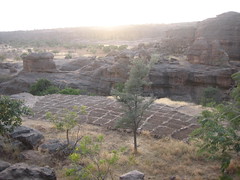
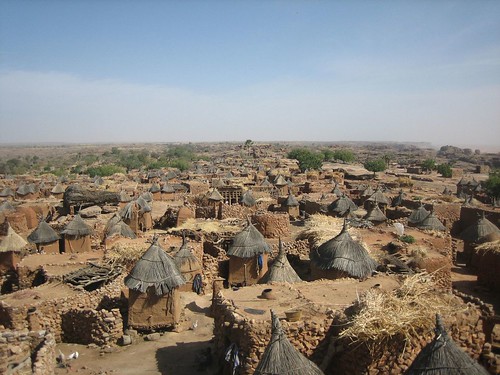
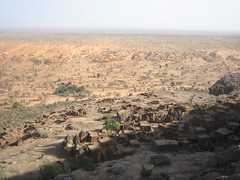
But not anymore, I just came back from a very exciting trip to West Africa and had the opportunity to visit Dogon Country in Mali, close to the border with Burkina Faso. Surrounded by dessert, Dogon Country refers to a series of villages located along a 150km escarpment and plateau. This dramatic landscape shelters one of the most "intact" cultures I ever seem: walking around their narrow mud house is like going back to prehistoric time. Unfortunately, the only sign of modernity is plastic junk that one sees scatter around....not too much though, and really very little compared to other places in Africa.

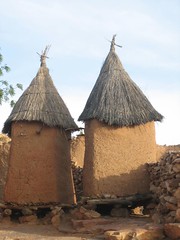
Grain Storage


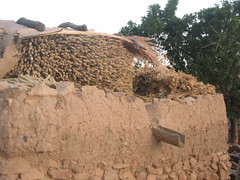
Picture above are one of the most common pieces of Dogon architecture: the granaries, usually filled with millet, sorghum and other indigenous grains, these will guarantee the food supply for the family until next rainy season. Tall and thin and made with a mix of mud and straw, they have to be above the ground to protect the grains from vermin. Inside, they are divided into diferent compartments that according to our guide represent the pattern of the cosmos. Dogon culture is very unique partially due to the harsh environment they inhabit and the long distance needed to reach the closest town. Very few product are imported from the urban centers and the only export, besides tourist souvenirs, are onions.


Gardens with Baobabs


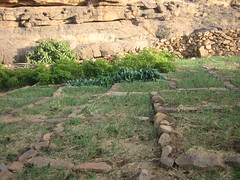
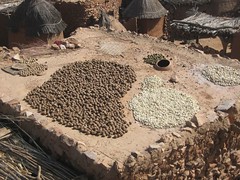
Onion were introduce by Marcel Griaule, a french anthropologist who exposed the Dogon to the rest of the world in the 40's. After living with them for 15 years, his studies concluded that the Dogon culture is extremely complex, a needed reputation for the people who many considered primitives. Among other things, he also taught them how to utilize their sandy soil to grow onions and helped them set up dams for irrigation. Today, the onions are sold throughout Mali and Burkina Faso. The picture above was taken at the village of Nombori, which is located at the bottom of the escarpment. For this reason, they have easier access to water allowing for thirsty vegetable to be grown. Up in the plateau, is really remarkable how as you walk from one village to another you see every little piece of land being utilized, with small plots of onions.


Onion Plots in Dogon Country Onions, Pepers, Cabagge

Ende, Dogon Village


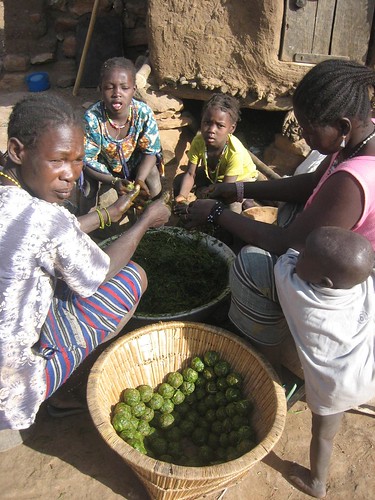
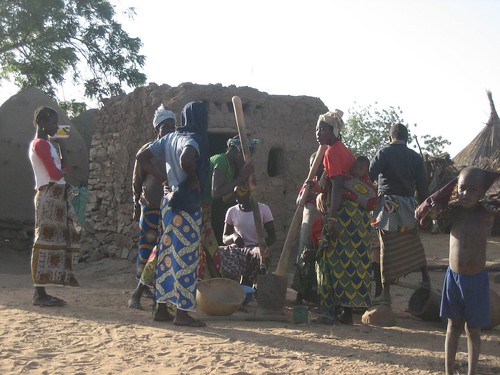
Women take the green part of the onions and smash them into balls. Gender roles are extremely important in Dogon society, and women are not in the best place, at least in comparison to western society. For instance, when women have their period, they're isolated in little huts; they have no say in all village affairs, and genital mutilation is still widely practice. During the days that we spend trekking around the villages, we saw women do most of the work: they look for wood and collect water, they pound the millet and work the fields. Men would spend a lot of time at the villages' meeting place, the Togu-na or Case a' Palabras. Here is where all the village affairs are discussed, not surprisingly women are not allowed. Something neat about these Togu-na is that they are very low, about 3ft to 4ft high. The idea is that you cannot stand so arguments always remain at the same level, calmed.

Togu-Na, Meeting place (Case a Palabres)

Onion balls


Getting back to the onion, the balls are then place in the roof of their huts. Once dry they are preserved and used for sauces. Other foodstuff are also dry in the roof to protect them from hungry goats and sheep that are commonly seem grazing around.


Millet being dry typical roof of dogon


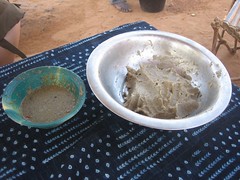
I had the opportunity to try millet fufu (boiled flour) with baobab sauce, made with dry onion leaves, fish powder, and baobab leafs, which if it wasn't for the slimy texture i would eat it everyday. Besides millet, eaten at all meals and in different ways, there is not much else. Those villages that have good access to water grow eggplants, squashes, tomatoes, and lettuce. But there is little meat, eggs, and milk. The tourist usually get a choice of beans and rice, couscous, or pasta, with a tomato based sauce a some chicken. Even though the food was ok, visiting latrines constantly and unwillingly became a big part of my trip.


Dogon Village, desert in the back Baobab with Millet Fufu....tasty


For the Dogon, agriculture plays an essential role into their lives. Every year as the rain comes, sprouts of life pop up from the soil signaling a good crop. The harvest will determine their imminent future. Once the rain has gone elsewhere, houses will have to be rebuilted and gods called upon for the next drop of water. This continuous cycle has kept pristine a culture that rejects the values of the many in other parts of the world. So different, so wrong and so right, it is difficult to predict their future: undoubtedly a very uncertain one, with a climate that seems to get hotter and hotter, plastic that remains in the ground after the rain is gone and a dessert that keeps covering the little top soil left with infertile sand.


Pounding Millet

WP Article on working abroad

Laying the Groundwork for Overseas WorkNearly Every Field Is International
By Lily WhitemanSpecial to The Washington Post. Sunday, March 9, 2008; K01

Michael Eschleman, the Peace Corps' country director for Paraguay, remembers discussing the guerrilla wars and revolutions of Latin America back in college.
"We said things like, 'The U.S. should do this' . . . or 'The campesinos in El Salvador should do that.'
"And suddenly, it hit me: How could I possibly know what our foreign policy should be, or recommend any course of action for other countries, if I had never visited them or even been out of the U.S.?"
Eschleman since has spent 15 years working in volunteer and then salaried positions on community development projects in Latin America for the Peace Corps.
If you would like to work overseas for the government, be aware that increased interest in foreign affairs has boosted competition for international careers, said Constance C. Jackson, associate administrator of the Agriculture Department's Foreign Agricultural Service.
Nevertheless, you can build credentials to impress federal employers:
Ƃ¿ Pursue your passions: Experts on international careers agree that almost all fields have international applications. So Betsy Davis, chief of the CIA's Recruitment and Retention Center, echoes the advice of many federal recruiters when she recommends preparing for an international career by "picking an area of study that you absolutely love and doing well at it."
She said, "When you are good at something, it shows."
Ƃ¿ Earn overseas experience: Study abroad or, during the summer or academic year, work on an overseas internship with the State Department, the U.S. Agency for International Development, the Foreign Agricultural Service, the International Trade Administration, or one of the international organization listed in the careers section of the State Department's Web site ( http://state.gov). Such internships offer experience with high-impact issues, including pollution, poverty and terrorism.
"The sky is the limit for interns who show aptitude," Jackson said. For example, one high-producing intern working in a temporarily short-staffed agricultural trade office in Moscow recently managed that office and oversaw preparations for a major trade show.
Peace Corps experience is also prized by federal employers. About a third of USAID's Foreign Service have it, said Thomas Davis, who works in USAID's human resources office.
Ƃ¿ Become worldly: Learn about international affairs through courses, travel and extracurricular activities. "Follow domestic and foreign media outlets, such as the Economist and the BBC, that offer strong international coverage and may be available online," said Isabel Otero, who works to improve Irish cancer research and care with the National Cancer Institute's Ireland-Northern Ireland Cancer Consortium.
Ƃ¿ Demonstrate your public-service mettle in the United States:"It would be great if everyone could go overseas, but if you can't -- and many people can't -- you can show your skills and dedication in different ways," said Marianne Myles, director of the State Department's employment office. She suggested joining service-oriented campus and community organizations. Others suggested working in disaster relief or in economically depressed areas in this country.
Ƃ¿ Hold domestic internships: Otero worked as an intern at the National Institutes of Health during high school and college and thus got her foot in the door at the Department of Health and Human Services. After college, she participated in that department's Emerging Leaders Program, which eventually led to her job at the National Cancer Institute.
Ƃ¿ Show leadership: Manage events, teams and seminars in school and lead projects at work, Myles said.
Ƃ¿ Seek mentors: Solicit career advice from international professionals whose footsteps you would like to follow, Eschleman said. "Everyone loves to talk about their experiences," he said.
Ƃ¿ Learn languages: Fluency in foreign languages is advantageous. But it's not a prerequisite, because many jobs provide language training.
Ƃ¿ Join professional organizations: Network and stay current in your field by using online and in-person resources provided by professional organizations and organizations addressing international issues, including the Society for International Development and the American Foreign Service Association.
Ƃ¿ Be persistent: Many job-seekers must submit multiple applications before landing overseas positions, Myles said.

Thursday, December 06, 2007

Fresh from the oven, The Economist article on the end of cheap food

Cheap no more
Dec 6th 2007 From The Economist print edition
Gerrit Buntrock
Rising incomes in Asia and ethanol subsidies in America have put an end to a long era of falling food prices
ONE of the odder features of last weekend's vote in Venezuela was that staple foods were in short supply. Something similar happened in Russia before its parliamentary election. Governments in both oil-rich countries had imposed controls on food prices, with the usual consequences. Such controls have been surprisingly widespread—a knee-jerk response to one of the most remarkable changes that food markets, indeed any markets, have seen for years: the end of cheap food.

In early September the world price of wheat rose to over $400 a tonne, the highest ever recorded. In May it had been around $200. Though in real terms its price is far below the heights it scaled in 1974, it is still twice the average of the past 25 years. Earlier this year the price of maize (corn) exceeded $175 a tonne, again a world record. It has fallen from its peak, as has that of wheat, but at $150 a tonne is still 50% above the average for 2006.
As the price of one crop shoots up, farmers plant it to take advantage, switching land from other uses. So a rise in wheat prices has knock-on effects on other crops. Rice prices have hit records this year, although their rise has been slower. The Economist's food-price index is now at its highest since it began in 1845, having risen by one-third in the past year.
Normally, sky-high food prices reflect scarcity caused by crop failure. Stocks are run down as everyone lives off last year's stores. This year harvests have been poor in some places, notably Australia, where the drought-hit wheat crop failed for the second year running. And world cereals stocks as a proportion of production are the lowest ever recorded. The run-down has been accentuated by the decision of large countries (America and China) to reduce stocks to save money.
Yet what is most remarkable about the present bout of “agflation” is that record prices are being achieved at a time not of scarcity but of abundance. According to the International Grains Council, a trade body based in London, this year's total cereals crop will be 1.66 billion tonnes, the largest on record and 89m tonnes more than last year's harvest, another bumper crop. That the biggest grain harvest the world has ever seen is not enough to forestall scarcity prices tells you that something fundamental is affecting the world's demand for cereals.
The meat of the question
Two things, in fact. One is increasing wealth in China and India. This is stoking demand for meat in those countries, in turn boosting the demand for cereals to feed to animals. The use of grains for bread, tortillas and chapattis is linked to the growth of the world's population. It has been flat for decades, reflecting the slowing of population growth. But demand for meat is tied to economic growth (see chart 1) and global GDP is now in its fifth successive year of expansion at a rate of 4%-plus.
Higher incomes in India and China have made hundreds of millions of people rich enough to afford meat and other foods. In 1985 the average Chinese consumer ate 20kg (44lb) of meat a year; now he eats more than 50kg. China's appetite for meat may be nearing satiation, but other countries are following behind: in developing countries as a whole, consumption of cereals has been flat since 1980, but demand for meat has doubled.
Not surprisingly, farmers are switching, too: they now feed about 200m-250m more tonnes of grain to their animals than they did 20 years ago. That increase alone accounts for a significant share of the world's total cereals crop. Calorie for calorie, you need more grain if you eat it transformed into meat than if you eat it as bread: it takes three kilograms of cereals to produce a kilo of pork, eight for a kilo of beef. So a shift in diet is multiplied many times over in the grain markets. Since the late 1980s an inexorable annual increase of 1-2% in the demand for feedgrains has ratcheted up the overall demand for cereals and pushed up prices.
Because this change in diet has been slow and incremental, it cannot explain the dramatic price movements of the past year. The second change can: the rampant demand for ethanol as fuel for American cars. In 2000 around 15m tonnes of America's maize crop was turned into ethanol; this year the quantity is likely to be around 85m tonnes. America is easily the world's largest maize exporter—and it now uses more of its maize crop for ethanol than it sells abroad.
Ethanol is the dominant reason for this year's increase in grain prices. It accounts for the rise in the price of maize because the federal government has in practice waded into the market to mop up about one-third of America's corn harvest. A big expansion of the ethanol programme in 2005 explains why maize prices started rising in the first place.
Ethanol accounts for some of the rise in the prices of other crops and foods too. Partly this is because maize is fed to animals, which are now more expensive to rear. Partly it is because America's farmers, eager to take advantage of the biofuels bonanza, went all out to produce maize this year, planting it on land previously devoted to wheat and soyabeans. This year America's maize harvest will be a jaw-dropping 335m tonnes, beating last year's by more than a quarter. The increase has been achieved partly at the expense of other food crops.
This year the overall decline in stockpiles of all cereals will be about 53m tonnes—a very rough indication of by how much demand is outstripping supply. The increase in the amount of American maize going just to ethanol is about 30m tonnes. In other words, the demands of America's ethanol programme alone account for over half the world's unmet need for cereals. Without that programme, food prices would not be rising anything like as quickly as they have been. According to the World Bank, the grain needed to fill up an SUV would feed a person for a year.
America's ethanol programme is a product of government subsidies. There are more than 200 different kinds, as well as a 54 cents-a-gallon tariff on imported ethanol. That keeps out greener Brazilian ethanol, which is made from sugar rather than maize. Federal subsidies alone cost $7 billion a year (equal to around $1.90 a gallon).
In theory, what governments mandate, they can also scrap. But that seems unlikely with oil at the sort of price that makes them especially eager to promote alternative fuels. Subsidies might be trimmed, of course, reducing demand occasionally; this is happening a bit now. And eventually, new technologies to convert biomass to liquid fuel will replace ethanol—but that will take time. For the moment, support for the ethanol programme seems secure. Hillary Clinton and John McCain used to be against ethanol subsidies, but have changed their minds. Russia and Venezuela are not the only countries that like to meddle in food markets for political reasons.
So demand for grain will probably remain high for a while. Demand, though, is only one side of the equation. Supply forms the other. If there is a run of bumper harvests, prices will fall back; if not, they will stay high.
Harvests can rise only if new land is brought into cultivation or yields go up. This can happen fairly quickly. The world's cereal farmers responded enthusiastically to price signals by planting more high-value crops. And so messed-up is much of the rich world's farming systems that farmers in the West have often been paid not to grow crops—something that can easily be reversed, as happened this year when the European Union suspended the “set aside” part of its common agricultural policy. Still, there are limits to how much harvests can be expanded in the short term. In general, says a new report by the International Food Policy Research Institute (IFPRI), which is financed by governments and development banks, the response tends to be sticky: a 10% rise in prices yields a 1-2% increase in supply.
In the longer run, plenty of new farmland could be ploughed up and many technological gains could be had. But much of the new land is in remote parts of Brazil, Russia, Kazakhstan, the Congo and Sudan: it would require big investments in roads and other infrastructure, which could take decades—and would often lead to the clearing of precious forest. Big gains could be had if genetically modified foods were brought into production or if new seed varieties were planted in Africa. But again, that will take time. Moreover, GM foods will not live up to their promise unless they shed the popular suspicion that dogs them, especially in Europe. And some of the new land—dry, marginal areas of Africa, Brazil and Kazakhstan—could be vulnerable to damage from global warming. By some measures, global warming could cut world farm output by as much as one-sixth by 2020. No less worryingly, high oil prices would depress the use of oil-based fertilisers, which have been behind much of the increase in farm production during the past half-century.
It is risky to predict long-run trends in farming—technology in particular always turns out unexpectedly—but most forecasters conclude from these conflicting currents that prices will stay high for as much as a decade. Because supplies will not match increases in demand, IFPRI believes, cereal prices will rise by between 10% and 20% by 2015. The UN's Food and Agriculture Organisation's forecast for 2016-17 is slightly higher. Whatever the exact amount, this year's agflation seems unlikely to be, as past rises have been, simply the upward side of a spike.
If prices do not fall back, this will mark a break with the past. For decades, prices of cereals and other foods have been in decline, both in the shops and on world markets. The IMF's index of food prices in 2005 was slightly lower than it had been in 1974, which means that in real terms food prices fell during those 30 years by three-quarters (see chart 2). In the 1960s food (including meals out) accounted for one-quarter of the average American's spending; by 2005 the share was less than one-seventh.
In other words, were food prices to stay more or less where they are today, it would be a radical departure from a past in which shoppers and farmers got used to a gentle decline in food prices year in, year out. It would put an end to the era of cheap food. And its effects would be felt everywhere, but especially in countries where food matters most: poor ones.
A blessing and a curse
If you took your cue from governments, you would conclude that dearer food was unequivocally a bad thing. About a score of countries have imposed food-price controls of some sort. Argentina, Morocco, Egypt, Mexico and China have put restraints on domestic prices. A dozen countries, including India, Vietnam, Serbia and Ukraine, have imposed export taxes or limited exports. Argentina and Russia have done both. In all these places governments are seeking to shelter their people from food-price rises by price controls. But dearer food is not a pure curse: it produces winners as well as losers.
Obviously, farmers benefit—if governments allow them to keep the gains. In America, the world's biggest agricultural exporter, net farm income this year will be $87 billion, 50% more than the average of the past ten years. The prairie farmers of the Midwest are looking forward to their Caribbean cruises.
Other beneficiaries are in poor countries. Food exporters such as India, South Africa and Swaziland will gain from increased export earnings. Countries such as Malawi and Zimbabwe, which used to export food but no longer do so, also stand to gain if they can boost their harvests. Given that commodity prices have been falling for so long in real terms, this would be an enormous relief to places that have suffered from a relentless decline in their terms of trade.
In emerging markets an income gap has opened up between cities and countryside over the past few years. As countries have diversified away from agriculture into industry and services, urban wages have outstripped rural ones. Income inequality is conventionally measured using a scale running from zero to one called the Gini coefficient. A score of 0.5 is the mark of a highly unequal society. The Asian Development Bank reckons that China's Gini coefficient rose from 0.41 in 1993 to 0.47 in 2004. If farm incomes in poor countries are pushed up by higher food prices, that could mitigate the growing gap between city and countryside. But will it?
Guess who loses
According to the World Bank, 3 billion people live in rural areas in developing countries, of whom 2.5 billion are involved in farming. That 3 billion includes three-quarters of the world's poorest people. So in principle the poor overall should gain from higher farm incomes. In practice many will not. There are large numbers of people who lose more from higher food bills than they gain from higher farm incomes. Exactly how many varies widely from place to place.
Among the losers from higher food prices are big importers. Japan, Mexico and Saudi Arabia will have to spend more to buy their food. Perhaps they can afford it. More worryingly, some of the poorest places in Asia (Bangladesh and Nepal) and Africa (Benin and Niger) also face higher food bills. Developing countries as a whole will spend over $50 billion importing cereals this year, 10% more than last.
Rising prices will also hurt the most vulnerable of all. The World Food Programme, the main provider of emergency food aid, says the cost of its operations has increased by more than half in the past five years and will rise by another third in the next two. Food-aid flows have fallen to their lowest level since 1973.
In every country, the least well-off consumers are hardest hit when food prices rise. This is true in rich and poor countries alike but the scale in the latter is altogether different. As Gary Becker, a Nobel economics laureate at the University of Chicago, points out, if food prices rise by one-third, they will reduce living standards in rich countries by about 3%, but in very poor ones by over 20%.
Not all consumers in poor countries are equally vulnerable. The food of the poor in the Andes, for example, is potatoes; in Ethiopia, teff: neither is traded much across borders, so producers and consumers are less affected by rising world prices. As the World Bank's annual World Development Report shows, the number of urban consumers varies from over half the total number of poor in Bolivia, to about a quarter in Zambia and Ethiopia, to less than a tenth in Vietnam and Cambodia.
But overall, enormous numbers of the poor—both urban and landless labourers—are net buyers of food, not net sellers. They have already been hard hit: witness the riots that took place in Mexico over tortilla prices earlier this year. According to IFPRI, the expansion of ethanol and other biofuels could reduce calorie intake by another 4-8% in Africa and 2-5% in Asia by 2020. For some countries, such as Afghanistan and Nigeria, which are only just above subsistence levels, such a fall in living standards could be catastrophic.
So it is no good saying “let them eat cake”: there are strong welfare arguments for helping those who stand to lose. But the way you do it matters. In general, it is better to subsidise poor peoples' incomes, rather than food prices: this distorts price signals the least and allows farmers to benefit from higher prices. Where it is not possible to subsidise incomes (because to do so requires a decent civil service), it is still possible to minimise the unintended consequences if food subsidies are targeted and temporary. Morocco fixed bread prices (the food of the poor) during Ramadan, the Muslim month of fasting; at the same time, it cut tariffs on food imports to increase competition.
AP
But a problem too
In contrast, Russia shows how not to do it. It imposed across-the-board price controls on milk, eggs, bread and other staples, benefiting everyone whether they needed help or not. Food is disappearing from shelves and farmers are bearing the brunt. As Don Mitchell of the World Bank points out, “if you want to help consumers, you can do it without destroying your producers but only if you go about it in the right way.” In reality, many of the recent price controls are blatant politicking. About half the countries that imposed price controls did so before elections or other big political events. Russia's are due to run out just after next year's presidential election. Funny, that.
There is one last important knock-on effect of agflation. It is likely to help shift the balance of power in the world economy further towards emerging markets. Higher food prices have increased inflation around the world, but by different amounts in different countries. In Europe and America food accounts for only about one-tenth of the consumer-price index, so even though food prices in rich countries are rising by around 5% a year, it has not made a big difference. There have been clucks of concern from the European Central Bank and a consumer boycott of pasta in Italy, but that is about all.
In poor countries, in contrast, food accounts for half or more of the consumer-price index (over two-thirds in Bangladesh and Nigeria). Here, higher food prices have had a much bigger impact. Inflation in food prices in emerging markets nearly doubled in the past year, to 11%; meat and egg prices in China have gone up by almost 50% (although that is partly because pork prices have been pushed up by a disease in pigs). This has dragged up headline inflation in emerging markets from around 6% in 2006 to over 8% now. In many countries, inflation is at its highest for a decade.
Central bankers are determined to ensure that what could be a one-off shift in food prices does not create continuing inflation by pushing up wages or creating expectations of higher prices. So they are tightening monetary policy. China increased interest rates in August, Chile in July, Mexico in May. The striking thing about these rises is that they are the opposite of what has been happening in some rich countries. The Federal Reserve reduced rates by 50 basis points in September and 25 points in October; the Bank of Canada cut rates this week. The indirect effect of food-price rises has therefore been to widen the interest-rate differential between rich and emerging markets.
And all this is going on as the economic balance of power is shifting. Growth in America and Europe is slowing; China and India are going great guns. Financial confidence in the West has been shaken by the subprime-mortgage crisis; capital flows into emerging markets are setting records.
This shift will be tricky to handle. Such transitions always are. The risk is of a bubble in emerging markets. As Simon Johnson, the IMF'S director of research, wryly notes, “every bubble starts with a change in the real economy.” Food markets are an obvious place to start. How emerging countries fare—and how poor consumers cope—depends on their economic policies. The imposition of food-price controls was not exactly a good start.

Friday, November 30, 2007

Nothing But Nets

Hi there,
Malaria prevention remains a very important component on the fight against poverty. The disease is the leading killer of children, having a huge impact in the development process of countries, specially those in subsaharan Africa. As my girlfriend helps CDC in a workshop on how to conduct mosquito nets survey in Togo and I get ready to take the stomach-upsetting malaria pills for my next trip, I found this global campaign on the matter that you readers should definitely check out.

This video tells you more about it. the website is http://www.nothingbutnets.org/

EVENTS: Transforming the Rural Nonfarm Economy: Opportunities and Threats in the Developing World

For those in the Washington Area, here is a very intersting event:

IFPRI, the Sustainable Rural and Urban Development Unit of the World Bank’s Development Research Department, and the World Bank’s InfoShop invite you to a panel discussion on

Transforming the Rural Nonfarm Economy: Opportunities and Threats in the Developing World

With

Paul Dorosh, World Bank
Steven Haggblade, Michigan State University
John Horton, Inter-American Development Bank
Forhad Shilpi, World Bank
Maximo Torero, IFPRI

At the World Bank InfoShop
Friday, 14 December 2007
12:00 – 1:30 pm

Abstract

Contrary to the conventional belief that rural economies subsist on agriculture, nonfarm work actually accounts for between one-third and one-half of rural incomes in the developing world. The nonfarm rural economy, a vibrant, often fast-growing, small-scale service and manufacturing sector, holds much promise both for overall economic growth and pro-poor rural and agricultural transformation. But it is also threatened by globalization, competition from larger businesses, and other trends.

How can this rapidly evolving segment of the economy contribute to economic growth and poverty reduction, despite the many risks? This new book, edited by Steven Haggblade, Thomas Reardon, and Peter Hazell and published by Johns Hopkins University Press on behalf of the International Food Policy Research Institute and the World Bank, answers this question in detail. Contributors examine the varied scale, structure, and composition of the rural nonfarm economy; the role of public intervention in this sector; the ways that poor people can successfully navigate the rapid transition underway in rural areas; and the most effective policy environment.

“Policymakers focus on macro-magnitudes first, urban-industrial growth next, agriculture last, and on the rural nonfarm economy hardly at all. Yet it creates at least one-third of rural income, output, and employment, and faces huge new prospects, but also huge threats, from post-liberalization supply chains. This path-breaking book organizes numerous examples and experiences into a new picture of what causes or impedes rural nonfarm growth, what makes it pro-poor, and what governments can do about it.”

--Michael Lipton, Research Professor of Economics, Poverty Research Unit, University of Sussex

This panel discussion on the book will include a question-and-answer session, as well as panelist presentations. The discussion will be held at the InfoShop, located at 701 18th St. NW, corner of 18th St. and Pennsylvania Ave.

Copies of the book will be available for purchase in the InfoShop bookstore after the event.

For more information on the book, visit http://www.ifpri.org/pubs/jhu/transformrural.asp.
Please RSVP to InfoShopevents@worldbank.org if you intend to come.

Paul Dorosh is a senior economist in the Bank's Spatial and Local Development Team of the Sustainable Development Network and a book contributor. Steven Haggblade is professor of International Development at Michigan State University . John Horton is a senior natural resource specialist at the Inter-American Development Bank. Forhad Shilpi is a senior economist in the Bank’s Sustainable Rural and Urban Development Unit of the Development Research Department. Maximo Torero is director of IFPRI's Markets, Trade, and Institutions Division.

Thomas Reardon, coeditor of the book, is a professor of agricultural economics at Michigan State University . Peter Hazell, coeditor of the book, is Visiting Professor at Imperial College, London, prior to which he was director of IFPRI’s Development Strategy and Governance Division. They both will be unable to attend but can be contacted at reardon@anr.msu.edu and p.hazell@cgiar.org, respectively.

About IFPRI
The International Food Policy Research Institute (IFPRI) was established in 1975 to provide sustainable solutions for ending hunger and poverty. IFPRI is one of 15 agricultural research centers that receive their principal funding from governments, private foundations, and international and regional organizations, most of which are members of the Consultative Group on International Agricultural Research.
For more information, visit http://www.ifpri.org.

About the InfoShop
The InfoShop is the public information center and development bookstore of the World Bank. It functions as the only publicly accessible space at headquarters, hosting book launches, exhibits, seminars, receptions, and other community outreach events.
For more information, visit http://www.worldbank.org.

Saturday, November 24, 2007

Corn

Corn

Hi there,
When I don't have anything relevant to say (at least for now), I post pictures, and today I'm doing just that.

Corn, the best friend of many people around the world, has been under though criticizing lately. With the release of the new documentary King Corn and pointed denunciation from the environmental community about corn-based ethanol, farmers are left questioning what is it that they have done. This Washington Post article explains all the components of the debate.

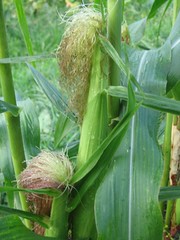
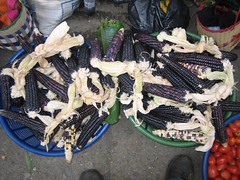
Now some photos!. The picture on top is from last year at my community garden plot. The cob on it came from one of the few plants that survive a heavy storm. The other picture is from a Mayan market in Guatemala, the closest I've been to corn's origin in southern Mexico.

Purple Corn sold at the local market

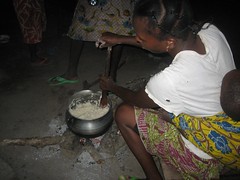
Finally, the picture beneath was taken a couple months ago in Togo. The lady is making Pot, basically corn flour boiled on water and eaten with meat or vegetables.

And here, from a new flickr contact Andrea Dunlap, a baby King Corn from the mountains of Peru. Click Here to see the flickr Picture


Making Corn Pot


King Corn Preview


Wednesday, November 14, 2007

Ag-Biotech Updates

Control of Coleopteran Insect Pests through RNA Interference Source:Nature BiotechnologyAuthor:James A. Baum
Chinese researchers say they may have found a way to overcome the resistance of cotton bollworms (Helicoverpa armigera) to the inhibitory chemical gossypol, which is produced naturally by cotton plants. The researchers identified the cotton bollworm gene, called CYP6AE14, that confers resistance to gossypol. They then genetically engineered cotton plants that produce a piece of double-stranded RNA which is specific to the CYP6AE14 gene. The researchers found that the RNA acts to "silence" the CYP6AE14 gene, thus restoring the effects of gossypol and retarding the growth of cotton bollworm larvae that try to feed on genetically modified (GM) cotton. The researchers write that this may be a general strategy for triggering "RNA interference" and could find applications in entomological research and field control of cotton bollworms. Their research was funded by the National Science Foundation of China, the Chinese Academy of Sciences, and China's Ministry of Science and Technology. The article can be viewed online at the link below, with a paid subscription to the journal Nature Biotechnology.
http://www.nature.com/nbt/journal/v25/n11/pdf/nbt1359.pdf


Kenya Government Committed to Biosafety Bill 2007 Source:Crop Biotech Update
Author:n/a
Kenyan Agriculture Secretary Wilson Songa has reported that the country's draft Biosafety Bill was not discussed during the last meeting of Parliament. Songa said, however, that the government will continue to advocate for passage of the law when the Kenyan parliament reconvenes in March 2008. Songa was speaking at the official opening of the Eighth Meeting of Stakeholders of the Insect Resistant Maize for Africa (IRMA) project, which is undertaken jointly by the Kenya Agricultural Research Institute (KARI) and the International Maize and Wheat Improvement Center (CIMMYT). The article can be viewed online at the link below.
http://www.isaaa.org/kc/cropbiotechupdate/online/default.asp?Date=11/9/2007#1197+

GMO: Kenyan Minister Disowns Draft Biosafety Law Source:Africa Science NewsAuthor:June Ngetich
Kenyan Environment and Natural Resources Minister David Mwiraria has said that the Environmental Management Authority (NEMA) lacks the capacity to identify genetically modified organisms (GMOs) and make decisions about whether they should be released in the environment and on the market. Mwiraria also stated that environmental and civil society groups consider GMO research and biosafety processes to be unaccountable and non-transparent. These and other remarks were part of a statement by Mwiraria that was read out loud at the opening of a six-day training for NEMA staff on GMO Biosafety Risk Assessment. The article says that Mwiraria's statement comes as the Kenyan government is distancing itself from a draft Biosafety Bill. The article says this bill has been in the public domain for close to 15 years. The article can be viewed online at the link below.
http://africasciencenews.org/asns/index.php?option=com_content&task=view&id=73&Itemid=1

The Economic Impacts of Introducing Bt Technology in Smallholder Cotton Production Systems of West Africa: A Case Study from Mali Source:AgBioForumAuthor:Jeffrey Vitale et al.
This article by researchers at Purdue and Oklahoma State universities in the U.S. uses an economic model to predict what would be the economic impacts on farmers and consumers if Bt crops were introduced to smallholder cotton and maize farms in Mali. Results indicate that the potential economic impacts to West African consumers and producers would be significant, potentially reaching $89 million in an average year. In the case of Bt cotton, the article finds that where seed company revenues are maximized, and the companies charge an additional US$60 per hectare, Malian farmers would capture 74 percent of the financial benefits. The seed companies would capture the other 26 percent. The article finds that adoption of Bt maize in Mali would be weaker than adoption of Bt cotton, at least in the absence of complementary changes in maize markets and technology. If Malian maize farmers were charged the same technology premium as South African producers, the model found that adoption would be at less than 10 percent. The article can be viewed online at the link below.
http://www.agbioforum.org/v10n2/v10n2a02-vitale.htm

Market and Welfare Effects of GMO Introduction in Small Open Economies Source:AgBioForumAuthor:Alejandro Plastina and Konstantinos Giannakas
This article by researchers at the University of Nebraska in the U.S. tries to sort out how farmers and consumers in small "open" developing economies would be affected by the introduction of genetically modified (GM) products. Economic modeling indicates that while the agronomic benefits associated with the introduction of the first-generation, farmer-oriented GM products are "certainly important," their presence does not guarantee welfare gains to small developing countries. The introduction of GM products is shown to create winners and losers among the consumers and producers of these small open economies. The model finds that the hypothetical introduction of GM products without domestic labeling requirements creates more economic benefits for consumers than when labels are required. The article can be viewed online at the link below.
http://www.agbioforum.org/v10n2/v10n2a05-giannakas.htm

Japan Says No to GMO Source:Rural Press LimitedAuthor:n/a
A delegation from the No! GMO Campaign, an alliance of Japanese groups representing 2.9 million Japanese consumers, has visited Australia and urged against the lifting of Australian state bans on genetically modified (GM) food crops. The delegation met with officials from the states of South Australia, Victoria, and New South Wales. The group used the opportunity to express concerns about GM foods, and presented a petition signed by 155 Japanese consumer and farmer organizations representing the 2.9 million Japanese consumers. Campaign spokesman Ryoko Shimizu, said: "We Japanese consumers are now standing at a critical crossroads in assuring our food safety . . . Australia is the only country that can supply GM-free canola to food-importing countries like Japan. If the moratoria are lifted it would damage the reputation of Australian crops in Japan and Japanese consumers would stop buying Australian crops." GM canola has been approved by the Australian federal government but banned by the individual states. Several Australian states are now considering whether to life their bans. The article can be viewed online at the link below.
http://www.checkbiotech.org/green_News_Genetics.aspx?infoId=15974

GM Crops - Asian Farmers Have Their Say Source:SciDev.NetAuthor:Jia Hepeng
Farmers participating in a recent Asian Regional Farmers' Exchange Program in the Philippines were asked about their thoughts and experiences with genetically modified (GM) crops. Many said they welcome GM crops, according to this feature article. Zu Maotang, president of the Farmer's Association of Gaobeidian City in the northern Chinese province of Hebei, is one such farmer. Zu said, however, that a dramatic reduction in bollworms achieved through the adoption of Bt cotton has coincided with outbreaks of other pests, especially mirid bugs. Agricultural scientists reassured Zu that increased insecticide spraying in the early stages of the mirid bug life-cycle could deal with the insects, but he said that many of his fellow farmers were startled when the bugs appeared, because they had been convinced that Bt-cotton was insect-free cotton. He wondered whether "Perhaps scientists will soon identify a gene against mirids." Kraisorn Kunluechakorn, a farmer and small seed dealer from Thailand, expressed more caution, saying, "Despite the benefits we have seen here [in the Philippines], we would not lobby the government for GM crops. Who knows if it's good or bad in the long term?" The feature article can be viewed online at the link below.
http://www.scidev.net/content/features/eng/gm-crops--asian-farmers-have-their-say.cfm

Massive Rise in GM Farming Still Not Enough, Says Europe\'s Biotech Industry Source:EuropaBioAuthor:n/a
EuropaBio, the European bioindustries association, has reported a 77 percent increase over the past 12 months in the area planted to genetically modified (GM) crops in Europe. The group says that more than 1,000 square kilometers of GM crops have been harvested. [According to a related article (BBC; October 29), a Bt maize variety resistant to the corn borer is the only GM crop grown widely in Europe. Planted in Spain for the last 10 years, it is now proving popular in France where the acreage has tripled in a year and also in Germany and the Czech Republic. The French president recently placed a temporary ban on GM planting, however, and some environmental groups claim that beneficial insects could be harmed by Bt maize. EuropaBio argues that GM maize is appealing to farmers and safe for the environment.] The press release can be viewed online at the link below.
http://www.checkbiotech.org/green_News_Genetics.aspx?infoId=16028

New Breed of Seed Source:IndyStar.comAuthor:John Russell
Dow AgroSciences has said that over the next three years, it wants to produce a genetically modified (GM) seed called SmartStax with eight genetic traits to fight pests and weed killers on "multiple fronts". The article says that would be significantly more than the maximum of three traits in GM seeds that are currently on the market. The article can be viewed online at the link below.
http://www.checkbiotech.org/green_News_Genetics.aspx?infoId=16007

Modified Toxin Helps Crops Kill Resistant Insects Source:NatureAuthor:Heidi Ledford
Researchers at National Autonomous University of Mexico and the University of Arizona in the U.S. have modified Bt toxins to make it more difficult for insects to develop resistance. Their work has been published in the journal Science. More work will need to be done to see whether plants can be genetically engineered to produce the modified form of toxin, according to the article. Bruce Tabashnik, an entomologist at the University of Arizona and a member of the research team, says it is "almost inevitable" that insects will develop resistance to the Bt toxin. So far, the article says resistance has only been documented in the field for two insects: diamondback moths (Plutella xylostella ) and cabbage loopers (Trichoplusia ni), both of which produce larvae that feed on vegetable crops. The resistant insects have only been found in fields and greenhouses where Bt is sprayed as an environmentally-friendly pesticide, not in fields planted with Bt-producing genetically modified (GM) crops. The article says that biotechnology companies are pursuing several options to prevent Bt resistance from developing among insect populations. These include selling GM crops that contain two different Bt toxins which bind to separate receptors found in insect guts. Researchers are also developing plants that produce an entirely different toxin, normally made by bacteria that live in nematode worm guts. William Moar, an entomologist at Auburn University in U.S., comments that the modified Bt toxin could make a useful addition to this "arsenal." The article can be viewed online at the link below.
http://www.checkbiotech.org/green_News_Genetics.aspx?infoId=16048

Non-target Effects of Bt Crops Database Available Source:ISB NewsAuthor:L. LaReesa Wolfenbarger
A comprehensive new public database houses information from 171 scientific studies of the effects of Bt crops on non-target arthropods (including insects and arachnids). The database is designed to facilitate a quantitative approach to synthesizing available studies on the effects of Bt crops. The online database contains 5,758 "experimental comparisons" obtained from the 171 studies. An extensive search was conducted to find these studies, and each study featured in the database meets four criteria: 1) it involves a Bt field crop; 2) it measures an effect on a non-target arthropod; 3) its design includes a non-transgenic control or varies exposure levels to Bt plants or their products; and 4) it is in English. About half the studies are based on laboratory work and about half on field trials. Author affiliations for the studies include academic institutions, government, corporations, and non-profit organizations, with the largest contributor being academic institutions. Publications on the non-target effect of Bt crops on arthropods began in 1992 with the majority of studies published after 2000. The database is available online at the link below.
http://delphi.nceas.ucsb.edu/btcrops

Genetic Approach to Identifying Bt Resistance Genes in Heliothis Virescens Source:ISB NewsAuthor:Joan LeGloahec and Linda J. Gahan
Researchers in the U.S. have developed varieties of Heliothis virescens (Hv) in the laboratory that are resistant to the Bt toxin Cry1Ac, produced in many insect resistant genetically modified (GM) crops. Their purpose was to identify what sort of genetic mutation can lead to Bt resistance. The article says this information is of interest to scientists who want to assist farmers with pest management. The article can be viewed online at the link below.
http://www.isb.vt.edu/news/2007/news07.nov.htm#nov0703

New Leadership for CIMMYT Source:Crop Biotech UpdateAuthor:n/a
Thomas Lumpkin, the current director general of the World Vegetable Center's Asian Vegetable Research and Development Center (AVRDC) in Taiwan, has been chosen to succeed Masa Iwanaga as director general of the International Maize and Wheat Improvement Center (CIMMYT), based in Mexico. Lumpkin, a respected scientist and science administrator, will assume the new post on March 15. CIMMYT is one of the research centers of the Consultative Group on International Agricultural Research (CGIAR). The article can be viewed online at the link below.
http://www.isaaa.org/kc/cropbiotechupdate/online/default.asp?Date=10/31/2007#1124