Tuesday, October 04, 2011
Development Studies Books
Monday, September 26, 2011
Bringing Nutrition to the Forefront of Agriculture
Grains and Leaves: Weekly Ag-Related News, Events, and Others
- World Bank publishes its 2012 World Development Report: Gender Equality and Development,
- The International Federation of Red Cross and Red Crescent Societies, publishes its World Disasters Report 2011- Focus on hunger and malnutrition
- On the Journal Nature, Jason Clay, senior vice-president of market transformation at WWF, identifies eight steps that, taken together, could enable farming to feed 10 billion people and keep Earth habitable: Freeze the Footprint of Food
- From the Chicago Council on Global Affairs: Bringing Agriculture to the Table :How Agriculture and Food Can Play a Role in Preventing Chronic Disease
- UK's Government: The Future of Food and Farming: Challenges and choices for global sustainability
- Yuan Longping, the "Father of Hybrid Rice," reports yields of 13.9 tons of rice a hectare on his latest variety, the DH2525
- Hillary Clinton, Secretary of State of the United States & Nick Kristof, moderator and columnist for The New York Times, talk about the central role of women in improving global food security. Similarly, Clinton also announced the allocation of $5 million this year by the US government to promote gender equality in agriculture and land use as part of the Feed the Future Initiative. Video available HERE
- Mark your calendars for the annual Norman E. Borlaug International Symposium and the World Food Prize Laureate Award Ceremony, Sept 12-14
- How to ensure increasing yields also translate into better nutrition? USAID’s Infant and Young Child Nutrition Project (IYCN) tackles the issues with the development of “nutritional impact assessment tool”
- "To feed more than 9 billion people in 2050, agricultural production will have to double in developing countries. It is time to reinvest in the agricultural sector", says the lastest Communique from the G20's Ministerial Meeting on Development
- An Oxfam briefing paper reports that vulnerable farmers are being pushed to marginal lands as African farm investments expand. Coverage on the issues by NY Times.
- From the Journal Solutions, A New Approach To Feeding The World, from World Resources Report (WRR). Check out below their chart contrasting today's approach to tomorrows'
Sunday, September 25, 2011
Gordon Conway on the Legacy of Chambers and a must have Practicioner Guide
2) The second link I wanted to share is a lecture professor Gordon Conway, an expert on agricultural ecology and professor at the Imperial College of London, gave on the work of Robert Chambers. Chambers, one of the most renowned development scholars and author of the seminal "Rural Development: Putting the First Last" was one of the leading voices on the importance of engaging farmers in a significant way - one in which their voice shapes the nature of the intervention. In the video below, Conway discusses the legacy to Chamber's work and presents the current challenges the world faces in issues of food security.
"We have to keep remembering that there is a huge private sector in Africa and Asia; is called farmers...and they deal in the private sector, and they need incomes. It's not just sustainable existence, it's sustainable development we are after" Gordon Conway
Monday, September 19, 2011
Somalia and the Need for Agricultural Investments
Friday, September 16, 2011
Rice, That's What's for Dinner: Columbia University Hosts Bob Zeigler to Discuss Global Food trends and the Importance of Rice and Agricultural Research in Addressing World Hunger
Tuesday, September 13, 2011
Food Prices and What to do About it
| Indigenous Corn: Guatemala 2006. R. Merchan |
However, there are two underlying factors that help us explain the higher demand for food commodities: a) societies are getting richer -and likely to consume more protein-based diets which demand more grains for fed- and b) grains and other commodities are being transformed into fuels, decreasing the amount of food available in the world market.
So what to do as the number of hungry people continues to grow to more than a billion? Essentially there are two ways of addressing the issue and both boiled down to increasing the availability of grains, cereals, and roots. The first one is by intensifying the use of land already in agriculture. This means means incorporating irrigation, fertilizers, hybrid and GMOs seeds, mechanization, and other modern practices that essentially result in increased yields.
The second way to tackle the increasing price of foods is to extend the area of agricultural land. A recent World Bank publication concluded that there are close to half a million hectares of land suitable for agricultural expansion all over the world. Most of these lands, about 200,000 ha, are located in Sub-Saharan Africa where large swaps of depleted lands have been abandoned, but could easily be brought back to production with the right mixture of fertilizer use and irrigation. Another area to take into account in its potential for agricultural increase is the Matto Grosso in Brazil. Although these soils are poor and mainly use for cattle, they have tremendous potential for large soy-bean crops. Environmentally, however, this could threaten the amazon by pushing further into the forest clearings for cattle.
The road, however, to increasing agricultural productivity is filled with blocks. In a recent article, NY Times, commentator Ninia V. Fedoroff, a professor of biology at Pennsylvania State University, argues that the Obama administration and the EPA's 'regulatory burden [is] slowing down the development of genetically modified crops.'
Another interesting point made recently by at The Guardian in light of the G20 meeting in Montpellier, France, on agricultural research and development is the lack of consensus among donor countries regarding the best way to increase agricultural production:
With an alphabet soup of organisations involved in agricultural research at national and international level, developing a coherent approach, setting out priorities and fulfilling objectives is problematic.Regardless of which strategy is followed, it's clear that both donor and host countries must truly commit to devoting the needed funds to the agriculture sector. Yet, given that the commitments made at L'Aquila by the G20 continue to be largely unfulfilled, the prospects of food prices coming down due to increase in food availability are very dim.
Friday, September 09, 2011
Farming for Women Victims of Rape in DR Congo
Field of Hope - Witness - Al Jazeera English
Tuesday, May 10, 2011
Article: The New Geopolitics of Food
Gates Foundation Challenge: Small Farmers are the Answer
Thursday, March 03, 2011
New Resources for Agriculture Project Designers
Wednesday, March 02, 2011
Excellent Special Report on Feeding the World
There are plenty of reasons to worry about food: uncertain politics, volatile prices, hunger amid plenty. Yet when all is said and done, the world is at the start of a new agricultural revolution that could, for the first time ever, feed all mankind adequately. The genomes of most major crops have been sequenced and the benefits of that are starting to appear. Countries from Brazil to Vietnam have shown that, given the right technology, sensible policies and a bit of luck, they can transform themselves from basket cases to bread baskets. That, surely, is cause for optimism.
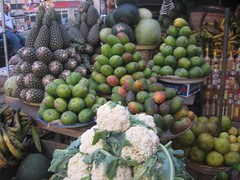
Also, do you know what this is? I tried it at Guatemala's City Central Market but I can't remember its name:
Tuesday, March 01, 2011
McGovern Remarks on Food Security
M. Speaker. At the end of January, the United Nations reported that the cost of basic food commodities – basic grains, vegetable oils, sugar – were at their highest levels since the UN created this index in 1990.
Two weeks ago, World Bank President Robert Zoellick announced that the Bank’s Food Price Index shows food prices are now 29% higher than they were a year ago.
Zoellick warned the G-20 to “put food first” when they next meet. The World Bank estimates that these recent food price spikes have pushed about 44 million people into extreme poverty. That’s under a dollar and twenty-five cents a day.
This is a global security crisis.
The lack of food security contributes to political instability – food was a primary reason people first took to the streets in Tunisia. Food and poverty were right at the top of the list in the squares of Egypt, right next to the call for political freedom.
In 2007 to 2008, the last global food crisis, there were major food riots in nearly 40 countries.
In May 2008, my fellow Co-Chair of the House Hunger Caucus Congresswoman Emerson and I were briefed by the GAO about the lack of coordination and continuity in U.S. food and development programs. We started calling for a comprehensive approach to address global hunger and food insecurity.
Under the leadership of Secretary of State Hillary Clinton and USAID Administrator Raj Shah, the U.S. government responded to that call – and over a two-year period of time initiated a comprehensive, government-wide approach to reduce global hunger and increase nutrition and food security. Not because it feels good. Not even because it’s the right and moral thing to do. But because it’s in our national security and economic interests to make countries food secure, more productive, healthier and more stable.
This strategy is known as the Global Hunger and Food Security Initiative. It includes our bilateral programs and efforts with other governments and multilateral institutions. To be successful, everyone has to pitch in.
Feed the Future is the signature program of the U.S. strategy. It works with small farmers and governments to increase agricultural production and strengthen local and regional markets in order to reduce hunger and grow economies.
Other key elements include the McGovern-Dole Food for Education and Child Nutrition Program that brings kids to school and keeps them there by making sure they get at least one nutritious meal each day at school. This program has proven to be especially effective at convincing families to send their daughters to school.
And finally, there is our Food for Peace Program, which provides food to millions of women, children and men caught in life-threatening situations brought on by natural disasters, war and internal conflict. This program provides U.S.-grown commodities and locally purchased foods that literally keep people trying to survive the world’s most dangerous situations alive.
M. Speaker, I have never heard anyone say that they would like to see more hunger in the world – that they would like to see children too weak from hunger to be able to learn, or young girls forced to work long hours because they are no longer being fed at school.
But that’s what the budget cuts that passed the House one week ago would do. The House cut $800 million out of the food aid budget and over 40 percent from Development Assistance, which is where Feed the Future is funded.
If these short-sighted and callous cuts are allowed to stand, we would literally be taking the food out of the mouths of over 2 million children. We would be depriving over 18 million people the food that keeps them alive – in Haiti, Darfur, Afghanistan, Guatemala, Ethiopia, Kenya and elsewhere.
We would be turning our backs on countries where we made commitments to help boost the production of their own small farmers so that they could finally free themselves of having to depend on U.S. and international food aid to feed their own people.
Enough, M. Speaker! Enough! This isn’t a question of charity. It’s an issue of national security – of what happens when desperate people can’t find or afford food, and the anger that comes from people who see no future for their children except poverty and death.
I ask President Obama to stand up for his programs and fight for them.
I ask the White House to hold a Summit on hunger, nutrition and food security – both here in the U.S. and globally.
I ask the media to wake up and grasp the consequences of these short-sighted cuts.
I call upon my colleagues, on both sides of the aisle, to fund these programs so that they can be successful. It really is a matter of life and death.
Friday, February 04, 2011
IFPRI Papers to be presented at the Leveraging Agriculture for Nutrition and Health Conference in India
IFPRI has posted copies of their papers to be presented at next week's New Delhi conference: Leveraging Agriculture for Nutrition and Health
http://www.ifpri.org/publications/results/taxonomy%3A933
- Project Papers and Notes
February 2011
The nexus between agriculture and nutrition
- Project Papers and Notes
February 2011
Agriculture, health, and nutrition
- Project Papers and Notes
February 2011
- Project Papers and Notes
February 2011
Feeding the future's changing diets
- Project Papers and Notes
February 2011
Responding to health risks along the value chain
- Project Papers and Notes
February 2011
Governing the dietary transition
- Project Papers and Notes
February 2011
Growth is good, but is not enough to improve nutrition
- Project Papers and Notes
February 2011
Turning economic growth into nutrition-sensitive growth
- Project Papers and Notes
February 2011
The role of agricultural growth in reducing poverty and hunger
- Project Papers and Notes
February 2011
Exploring the agriculture–nutrition disconnect in India
Thursday, January 27, 2011
Robert Zoellick on the World's Challenges
By R. M. Schneiderman
In the lead-up to the World Economic Forum in Davos, NEWSWEEK's R. M. Schneiderman interviewed World Bank president Robert B. Zoellick about the future of the global economy.
What is the biggest challenge facing the developing world in 2011?
The biggest challenge facing most developing countries is the risk of a big boost in food prices. Food accounts for a large and increasingly volatile share of family budgets for poor and urban families. When prices of staple foods soar, poor countries and poor people bear the brunt. France's President Sarkozy, Chair of the G-8 and G-20 this year, has rightly identified this issue as a priority.
How can the globe assure food security in the face of rising prices?
There are two interrelated challenges. First, we need to increase food productivity and production in developing countries, especially in sub-Saharan Africa and with small-holder farmers. To do so, we need to fix problems all along the "value chain": property rights; R&D for seeds and inputs; irrigation; fertilizer; agricultural extension; credit; rural infrastructure; storage; and connection to markets. The World Bank Group manages a Global Agriculture and Food Security Program, with contributions from six countries as of now and the Bill & Melinda Gates Foundation, to help promote investments in small-holder farmers. In 2011, I hope we can get more contributions. Separately, the World Bank Group is boosting investment in agriculture to about $6-8 billion a year through our lending and investment projects.
The second problem is the volatility of food prices, often because of events outside poor countries' control. An interconnected combination of steps could help ensure that the most vulnerable countries and people get the nutrition they need. For example, we can increase public information on the quality and quantity of grain stocks to reassure markets and calm panic-induced price spikes. We can improve long-range weather forecasting and monitoring, especially in Africa, to better prepare for dangers. Export bans exacerbate panic pricing, so we need a code of conduct that at least exempts humanitarian purchases from bans.
We can help small-holder farmers become a bigger part of the solution for food security through tenders from humanitarian purchasers such as the World Food Program. We need financial and other tools to help farmers and their governments manage risk, whether of rainfall, prices of inputs such as energy, or others. We may need small, regional humanitarian food reserves, too, in disaster-prone, infrastructure-poor areas. We should also ensure effective, targeted social safety nets so that we protect the most vulnerable populations, such as pregnant and lactating women and children under two. The bottom line: The G-20 should agree to "Put Food First."
What about the world economy?
For the world economy as a whole, the macro challenge is managing and enhancing a modest multispeed recovery that must steer clear of various shoals: for major emerging markets, avoiding overheating or bubbles in certain sectors; for the EU, navigating through sovereign debt icebergs that could puncture big holes in the financial sector; for the US, creating jobs today while breaking the wave of structural spending and debt increases; for all, setting course to make structural reforms suited to each economy to boost growth and a rebalanced international economy.
Wednesday, January 26, 2011
UK-commissioned Global Food and Farming Futures report released
Friday, January 21, 2011
Weekend Reading: Jan 21
- A comprehensive calendar of DC events and activities on food security an agriculture. Check it out from time to time and join the group
- Presentation and notes from the Driving Innovation: How Enterprise ICT Models are Changing Agricultural Extension event organized by USAID and Agrilinks
- Another relevant DC event on Food Security organized by MicroLinks: Pathways Out of Poverty: Using Value Chains to Move Vulnerable Households Up the Economic Ladder
- UC Davis Receives $40 M to Lead Major Multistate Ag Research Programs in the development of climate-change-tolerant wheat and barley plants and the other at sequencing the genomes of loblolly pine and two other conifers
- Event Notification: 5th World Congress on Conservation Agriculture
- World Watch Institute: State of the World 2011: Innovations that Nourish the Planet
- NYT's Dot Earth Blogs "Varied Menus for Sustaining a Well-Fed World" about opposing views on how to feed 9 billion people and the need for an 'all of the above approach.
- BBSRC and DFID, both partners in the UK's Global Food Security program, announce a new initiative to improve food security in the developing worl
Rafael
Administrator Shah’s Speech with CGD
Food Security: Instead of merely providing food aid in times of emergency, we are helping countries develop their own agricultural sectors, so that they can feed themselves. We launched Feed the Future – bringing together resources across the federal government and engaging in deeper partnerships to extend the impact of our efforts. We are now leveraging more investment from countries themselves and from other donors. Firms ranging from General Mills to local African seed companies are all doing more. As a result, in just five of our twenty focus countries we will be able to help nearly 6.5 million poor farmers – most of them women – grow enough food to feed their families and break the grip of hunger and poverty for tens of millions of people.
"At the end of the day, what we’re trying to do is create kind of commercially viable agriculture sectors in these countries to eliminate the fact that every time prices do spike a little bit, it creates a lot of unrest and a lot of human suffering".
Friday, December 24, 2010
Colors of Colombia
Apologies for not keeping the blog up to date, but for the past month I've been taking a break from my computer and electronic gadgets. Instead, I've been traveling around Colombia, starting in Boyaca where its cold climate is ideal for vegetables and fruits, to the Cauca Valley where sugar cane abounds. Books and articles about the role of land tenure in Colombia's conflict have also kept me busy. And while there is plenty of work that needs to be done in ensuring Colombian farmers have access to adequate land, there are hopeful news coming from the current government and its policies: an agriculture minister with an excellent background and recognized by critics to be committed to the issue of land reform, and backpedaling some of the disastrous laws and policies enacted during the previous administrative. Couple with a public who understands that the underlying problem behind Colombia's conflict is access to land, we hope to see real and significant policies to assist poor farmers.
Anyway, below are some pictures of my trip. Enjoy .
Land Grabs- a New Global Trend
Saturday, October 09, 2010
Climate Change Implication on Agriculture and CIAT's Work on it
Wknd Reading Oct 9th.
- The Global Agriculture and Food Security Program (GAFSP) Launches Official Website: GAFSP has launched an official website housing information on the fund, its recipients and the proposal process. The fund is a multilateral mechanism to assist in the implementation of pledges made by the G8++ at L'Aquila in July 2009 and set up in response to a request from the G20 in Pittsburgh in September 2009. The fund is administered by the World Bank and assist the programs resulting from the implementation of CAADP.
- We Can End Hunger: 10 Ways to Feed the World. Excellent article on the Huffington Post byJosette Sheeran, the Executive Director of the UN World Food Programme
- Ecoagriculture Partners announces CONFERENCE ON AGRICULTURE, FOOD SECURITY AND CLIMATE CHANGE
- Partnership to Cut Hunger and Poverty in Africa: News Brief: Week of October 4 2010
- Comprehensive African Agriculture Development Program (CAADP) e-Newsletters Issue 06 Tuesday, 5 October 2010. Check oped by Agnes Kalibata and Joseph Sam Sesay on the need for international support to African's green revolution
- World Bank: Improving Food Security and Livelihood in Ethiopia through Agricultural Growth
- Montana State University receives grant from the Bill & Melinda Gates Foundation to fight wheat rust http://www.montana.edu/cpa/news/nwview.php?article=8858
- Agricultural Biodiversity Weblog A breakthrough in West Africa?
- Cowpea scientists promise to end African hunger
- U.S. Seeks Supporters for $1 Billion Global Food Security Fund, Lago Says
- USAID's Impact Blog: Food Security Month @ USAID: Linking Agriculture, Economic Growth, and Nutrition
- Planting Now, Agricultural Challenges and Opportunities for Haiti's Reconstruction, Oxfam
- NYTimes Raisins Give Hope to Afghan Farmers
Sunday, October 03, 2010
This American Life on Hatian Devevlopment , Agriculture, and More
As as a big fan of This American Life, I was really pleased to hear a story about Haiti and the dificulties of making development work. Adam Davidson and Chana Joffe-Walt of Planet Money tell the story of a poor farmer with a couple of mango trees and enormous potential to get herself out poverty with a tiny bit of investment. As it turns out, this little investment requires navigating a complex set of culture dynamic, economic behavior, government red-tape, and NGO disincentives. This story showcases how NGOs can, sometimes, be the problem they are trying to solve; in Haiti, both the amount of non-profits and Haitians living in poverty continue to increase. This is another good story from National Public Radio about the endless debate greed and charity.
Thursday, September 23, 2010
Obama Presents his new Approch to Development
- A policy focused on sustainable development outcomes that places a premium on broad-based economic growth, democratic governance, game-changing innovations, and sustainable systems for meeting basic human needs;
- A new operational model that positions the United States to be a more effective partner and to leverage our leadership; and
- A modern architecture that elevates development and harnesses development capabilities spread across government in support of common objectives
Referring to the millions of people receiving food assistance from the WFP and others, President Obama said: "That's not development, that's dependence ... And it's a cycle we need to break. Instead of just managing poverty, we have to offer nations and people a path out of poverty." Then came a needed caveat: "the US has been and will remain the global leader in proving assistance. We will not abandon those that depend on us for life-saving aid."
Anticipating criticizing from foes about the US foreign aid agenda in times of economic pain and budget cuts, President Obama said "Let's put to rest the old myth that development is mere charity that does not serve our interests", and "reject the cynicism that certain countries are condemn to perpetual poverty." He went on to list examples of unprecedented development progress in the past 50 years and linked the development goals to domestic interest: "In our global economy, progress in even the poorest countries can advance the prosperity and security of people far beyond their borders, including my fellow Americans."
This focus on long-term development is already evident on initiatives such as Feed the Future and Global Health. See the full speech on the video below:
Sunday, September 19, 2010
Wknd Reading Sept 19: Sunday Edititon
- Sylvia Mathews Burwell, President of the Global Development Program of the Bill & Melinda Gates Foundation, writes about A Green Revolution Growing in West Africa
- For DC area resident, see list of different events on food security and agriculture happening in the next couple weeks.
- Why Stunting Matter? A very good technical brief from Alive and Thrive
- News Brief: Week of September 13 2010 from Partnership to Cut Hunger and Poverty in Africa
Wednesday, September 15, 2010
Oxfam International: Halving Hunger, Still Possible?
Tuesday, September 14, 2010
Funding Feed the Future Initiative:
| www.feedthefuture.gov. |
"Both House and Senate bills cut the $1.65 billion request for Feed the Future, but in different ways and in different amounts. The Senate provides $1.3 billion, with $250 million channeled through a World Bank managed multi-country fund for which the Administration had proposed $408 million. The House measure reduces this further to $1.15 billion, providing a direct appropriation to the multilateral fund of $150 million, with authority to transfer another $100 million from bilateral resources, at the President’s discretion".After its formal announcement at the G-20 summit in which the Obama administration proposed 1.4 billion for Agricultural Development, funding for the initiative had been uncertain, specially under the current political climate. Although FTF counted with bipartisan support, it seems that the program couldn't be isolated from other major cuts taking place across the federal board.
However, the important message continues laud and clear: this administration remains committed to international agriculture and food security programs. It's really up to other G-8 countries to fulfill their promises to provide $20 billion over the next three years towards agricultural development in impoverished countries. Most of that money is nowhere to be seen.
FAO: 925 Million in Chronic Hunger Worldwide
According to FAO, the reasons behind this reduction are twofold: 1) the reduction of food prices in developing countries from their peak levels in 2008 and 2) the projected economic growth in the developing countries for 2010. These have allowed poor people to buy more food. Although the developing world is faring this economic down-turn much better that developed countries, is hard to predict if lower prices and growth in the developing world will continue robustly. Instead, the trend has been quite the opposite, i.e since the mid- 1990s hunger has been increasing. Today, 16% of the world population remains hungry, six points away from the Millennium Development Goal of halving hunger by 2015.
This welcomed news must not hid the fact that nations need to address the underlying problems of hunger in other to empower people to either buy or produce enough food to meet their diet requirements. Essentially, African and South-Asian governments need to commit to a set of policies focusing on small farmers, helping them produce and market their products better. The Comprehensive African Agriculture Development Program (CAADP) and the government's Feed the Future Initiative are two steps in the right direction. However, in the former, few countries have reached the goal of spending 10% of their government expending on Agriculture, and in the later, the actual program implementation hasn't reach the field yet. Let's hope that African countries will strengthen their commitment to food security and agriculture, and that bi-lateral and multilateral support continue increasing agricultural spending. As U.S. Secretary of State Hillary Clinton said "We have the resources to give every person in the world the tools they need to feed themselves and their children. So the question is not whether we can end hunger. It's whether we will."
Monday, September 13, 2010
Wknd Reading Sept 13th: Monday Edition
Here is your reading list for the week(end):
- The new addition to our list of relevant reports: Rising Global Interest in Farmland: Can it Yield Sustainable and Equitable Benefits? This long report offers an analysis of the rush to secure food supply, triggered by the 2007-08 Food Crisis.
- Don't starve thy neighbor, The Economist
- Book: Toward Sustainable Agricultural Systems in the 21st Century. "This book assesses the scientific evidence for the strengths and weaknesses of different production, marketing, and policy approaches for improving and reducing the costs and unintended consequences of agricultural production. It discusses the principles underlying farming systems and practices that could improve the sustainability. serves as a valuable resource for policy makers, farmers, experts in food production and agribusiness, and federal regulatory agencies".
- NYTimes: Food Crisis Worsens in West Africa
- The first issue of the Journal of Agriculture, Food Systems, and Community Development (JAFSCD) is now online
- Christian Science Monitor: Mozambique bread riots may be warning sign on African food security
- Financial Times: Time is ripe for a global food plan
Hidden Hunger: the Impact of Chronic Malnutrition and Tools to Tackle it
Hidden Hunger from Bob Caputo on Vimeo.
Sunday, September 12, 2010
The Rockefeller Foundation Continued Support for Agricultural Development
As agriculture makes its come back to the development agenda, foundations continue to play a very important role, especially in cash strapped countries where these type of investments are critical to many subsistence farmers. Although the commendable work of the Gates and Melinda Foundation on agricultural development in Africa is more visible and gets more newswires, the Rockefeller Foundation deserves a lot of credit for their recent work in the continent. Between September 2-4 of this year, the foundation was one of the supporter of the Africa Green Revolution Forum. This needed platform gave voice to many experts from different African countries and elsewhere in the world to drive "agricultural productivity and income growth for African farmers in an environmentally sustainable way". During the conference, innovative ideas on food security and ag development were showcase and debated.
I'm glad that the foundation continues to follow its historical legacy and commitment to agricultural development. Maybe one of these experts will become the the next Dr. Norman Borlaug, only this time the grain and the continent will be different.
Enjoy this informative video the Rockefeller Foundation put together about the forum and their work in Africa.
Friday, August 13, 2010
Weekend Reading (WR) Aug 13
- Can Science Feed the World? Nature, August 2010: Excellent compilation of articles and agriculture research
- Gates Foundation inform us about their progress on Ag grants
- The Political Economy of Trade and Food Security. A good paper on global food security and what's needed to feed the one billion hungry and the many to come..the picture is quite bleak. One of the authors, M. Ann Tutwiler from USDA, plays a leadership role at Feed the Future Initiative
- Virginia's senator Jim Webb criticizes Millennium Challenge Account for a recent award given to a Chinese state-owned company to build an airport in Mali. Read why Webb's ideas are misguided and expensive
- An opinion piece by Gordon Conway on the Financial Time about the importance to honor the L'Aquila commitment and support ag-lead development
- Remarks from Jim Miller, USDA's Under Secretary for Farm and Foreign Agricultural Services at the International Food Aid and Development Conference in Kansas City
- IFPRI asks "Do Health Investments Improve Agricultural Productivity?" The answer, we don't know yet
Friday, July 23, 2010
Weekend Reading (WR)
- President Obama's announcement at the G8 Summit of "A New Approach to Global Development," outlining a more significant role for global development. See also the administration new initiative Feed the Future
- Events and Activities on agriculture and food security taking place in the Washington Area
- Two weeks away from the USDA & USAID 2010 International Food Aid & Development Conference in Kansas City MI . This blogger will be there
- Notes from IYCN's presentation on Maximizing Nutritional Benefits from Agricultural Interventions
- Informative blog on M&E in Development Project: Rick on the Road
- In grad school and wanting to do ag-related field research? Check A Guide to Effective and Relevant Graduate Research in Africa definitely of one the best resources I've seen
- Sign up for Global Food for Thought Listserv from the Chicago Council on Global Affairs. They send weekly emails with a plethora of reports, events, policy discussion, research and much more on international food security. Highly recommended
Friday, June 25, 2010
President Obama Outlines New Approach to Development
A New Approach to Advancing Development
At the Muskoka G8 Summit, President Obama outlined his views on a new approach to development. In his recently released National Security Strategy, development is recognized as a moral, strategic, and economic imperative for the United States and our partners. Development, diplomacy, and defense are components of a comprehensive, integrated approach to the challenges we face today. Countries that achieve sustained development gains make more capable partners, can engage in and contribute to the global economy, and provide citizens with the opportunity, means and freedom to improve their lives.
President Obama launched a study of U.S. development policy in September 2009 and will be issuing a new policy directive in the near future. The new U.S. development policy builds on two signature initiatives launched by the Obama Administration in 2009 to focus on results-based, strategic investments aimed at promoting meaningful and lasting results:
• Feed the Future: At the London G20 Summit in 2009, President Obama announced a global food security initiative that has the support of the world's major and emerging donor nations, includes strong roles for our multilateral institutions, and is led by partner countries that are ready and willing to develop comprehensive plans and commit their own resources to agricultural and market development. Secretary Clinton launched the comprehensive U.S. strategy – "Feed the Future" – to implement this groundbreaking effort in May 2010. To date, the United States has led international efforts to review nine comprehensive country strategies, commit new resources in support of those strategies, collaborate in the establishment and initial capitalization of the World Bank-led Global Agriculture and Food Security Program, and launch a new research and development program.
• Global Health Initiative: In May 2009, President Obama announced the Global Health Initiative (GHI), which builds on the progress and success of PEPFAR (the President's Emergency Program on AIDS Relief) and also expands our global health effort and impact by including investments to strengthen health systems, improve maternal child health, address neglected tropical diseases, and foster increased research and development. The GHI will integrate our health programs in order to reduce inefficiencies and expand impact, and is designed to save lives and achieve sustainable outcomes. This new, integrated approach will be fast-tracked in eight countries.
President Obama's new development policy will:
• Foster the Next Generation of Emerging Markets: The U.S. will intensify efforts to promote sustainable economic development and support good governance by making targeted investments in countries and/or regions where the conditions are right for progress.
• Invest in Game-Changing Innovations: By leveraging the power of research and development, the U.S. will work to create and scale-up technologies for health, green energy, agriculture, and other development applications.
• Meet Basic Human Needs in a Sustainable Fashion: The U.S. will continue to be a global leader in the meeting of basic human needs, but will place increasing emphasis on building sustainable public sector capacity to provide basic services over the long-term.
• Tailor Development Strategies: The U.S. will tailor development strategies in countries in or recovering from conflict to reflect the unique conditions on the ground, and will join efforts to promote stabilization and achieve security with those designed to promote our long-term sustainable development goals.
• Hold all Aid Recipients Accountable: The U.S. will seek sustained development progress in all countries receiving U.S. economic assistance by placing a greater focus on policy reforms key to development.
In addition, in pursuing these objectives, the U.S. will pursue a new approach to development that:
• Is More Selective: The U.S. will seek a division of labor with other donors and focus its efforts on select countries, regions, and sectors - while ensuring critical development needs are met.
• Leverages other Donors, Philanthropy, Diaspora and the Private Sector: The U.S. will seek a division of labor with other donors and make a concerted effort to partner with other actors to leverage U.S. investments.
• Underscores Country Ownership and Mutual Accountability: The U.S. will place a premium on partnering with countries that are well governed and will work to strengthen their institutions and support their development strategies.
• Strengthens Multilateral Capabilities: The U.S. will support multilateral development capabilities and support key reforms and the creation of new capabilities, where required.
• Drives Policy with Analysis: The U.S. will adopt metrics and set in place rigorous standards for monitoring and evaluation, and use data and analysis to drive decision-making.